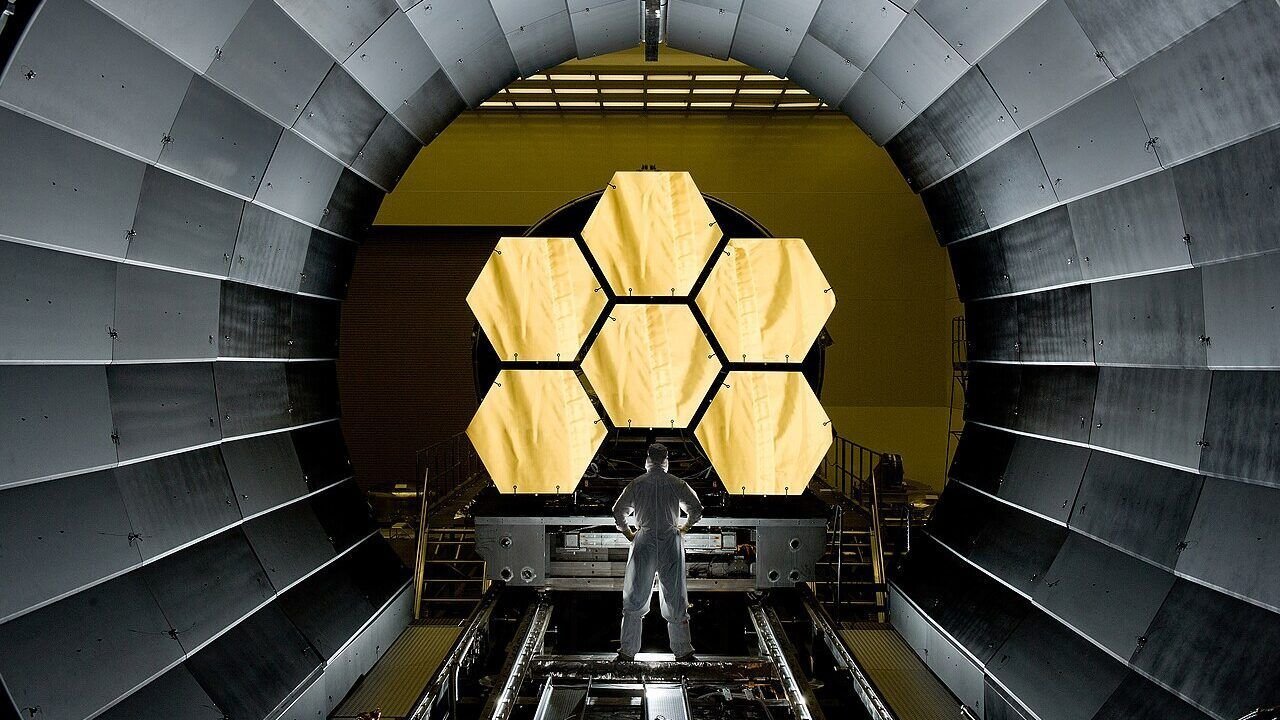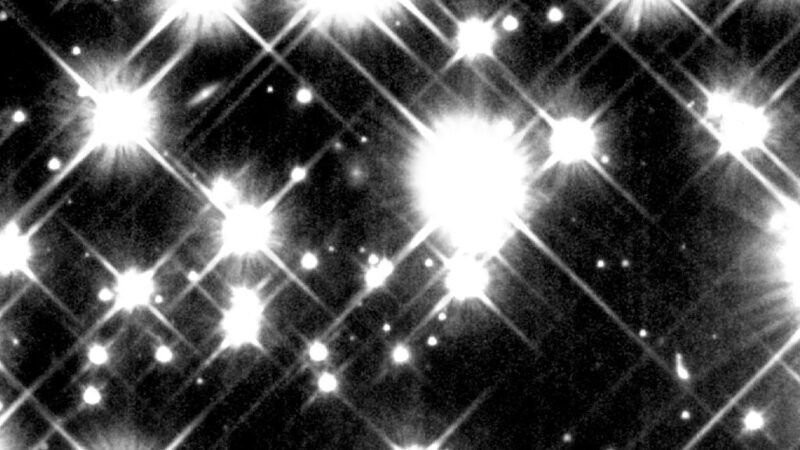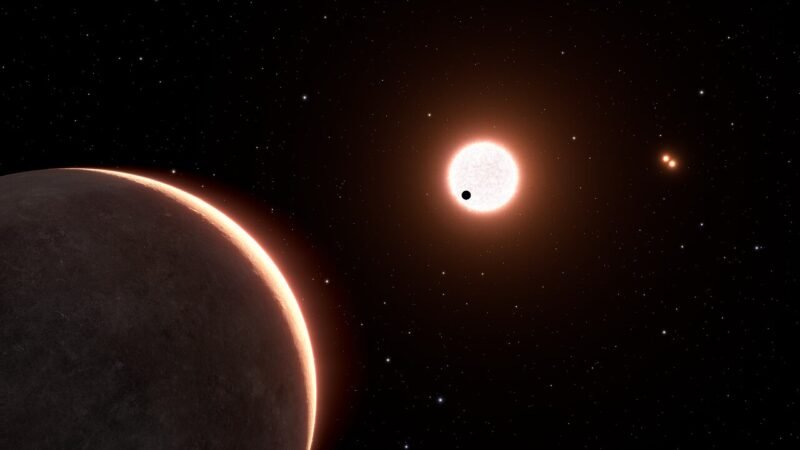

The James Webb Space Telescope has discovered an exoplanet that scientists did not previously know existed, the first entirely new world the observatory can claim, according to the international team behind the finding. Until now, Webb had mostly been used to study exoplanets already discovered by other means, characterising their atmospheres in unprecedented detail. This time it found one: a young gas giant roughly the size of Saturn, orbiting the star TWA 7 about 110 light-years from Earth in the constellation Antlia. The team, led by Dr Anne-Marie Lagrange of the Paris Observatory and Grenoble Alpes University, pointed Webb at TWA 7 and used instruments that block out the star’s light, allowing the telescope to observe much fainter objects nearby. That coronagraphic technique, suppressing a star’s glare to reveal its surroundings, is what separates direct imaging from the transit and radial-velocity methods that have found most known exoplanets: instead of inferring a planet from its effect on starlight, astronomers photograph it. France’s CNRS research centre said in a statement that the discovery represents a first for the telescope. Lagrange explained that Webb opens a new window, in terms of the mass of planets and their distance from their star, on exoplanets that had not been accessible to observation so far, and that this is important for exploring the diversity of exoplanetary systems and understanding how they form and evolve. Directly imaged planets skew young, large and wide-orbiting, because a newborn gas giant is still glowing with the heat of its formation and sits far enough from its star to be resolved. TWA 7b fits that profile, and its youth is scientifically valuable: catching a planetary system while its planets are still warm and its architecture still settling lets astronomers test formation models against a system in progress rather than inferring history from a finished one. The discovery also serves as a technology demonstration with a specific ambition attached. The team notes that the techniques proven here, starlight suppression plus sensitive infrared detection, are stepping stones toward imaging smaller planets closer to their stars, and Lagrange’s group hopes Webb can help discover Earth-like planets one day. That final step, a true Earth analogue photographed directly, remains beyond any current instrument; the star-planet contrast is roughly a billion to one in reflected light. But each new window in mass and separation narrows the gap that future observatories, with larger mirrors and better coronagraphs, are being designed to cross. Webb was sold to the public partly as a machine for studying other worlds, and most of its exoplanet headlines have concerned atmospheres of planets found by others. TWA 7b is different in kind: a world that was, until this observation, simply not in the catalogue. There are thousands of stars within a few hundred light-years whose planetary systems have never been imaged at all. The first new world found by the most powerful telescope ever flown is unlikely to be its last.
Webb Telescope Spots Its First Entirely New Exoplanet, a Young Gas Giant Called TWA 7b
The James Webb Space Telescope has discovered an exoplanet that scientists did not previously know existed, the first entirely new world the observatory can claim, according to the…