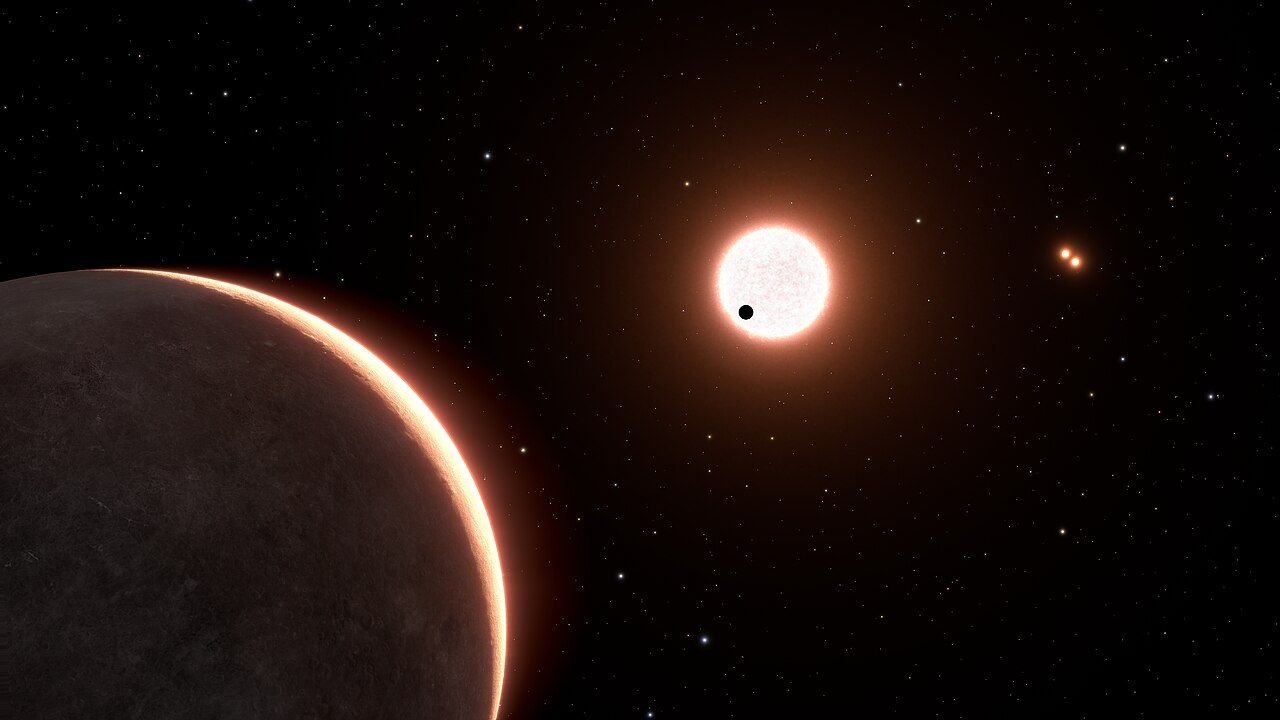
Astronomers may have directly detected the magnetic field of a planet outside our solar system for the first time, by tracking radio signals from the young giant planet Beta Pictoris b, according to a study reported this week. The planet, about 63 light-years away, was found to have a magnetic field roughly 2,000 times stronger than Earth’s, inferred from a pattern of radio emissions suggesting an intense auroral display, far more extreme than our northern lights. The team’s preprint paper, posted to a public archive on 15 September, has not yet been peer-reviewed, a qualification the researchers and outside experts both emphasise. If the conclusions hold up, one co-author said, the work opens a completely new window on planets outside our solar system; an independent radio astronomer not involved in the study called the result, if confirmed, a slam dunk. The difficulty the work addresses is fundamental. Astronomers have discovered more than 6,000 exoplanets, but for most they know only bare-minimum information: mass, radius, and perhaps some molecules in an atmosphere. Starlight glare, distance and Earth’s own atmosphere conspire against detail. Magnetic fields are among the most consequential of those missing details, because a field is generated by a planet’s interior, reveals information about its structure and rotation, and, in Earth’s case, shields the atmosphere and surface from the solar wind, a role often discussed in connection with habitability. Beta Pictoris b is an unusually favourable target: young, massive and orbiting a bright, nearby star whose system also hosts a famous debris disc, and it was directly imaged rather than inferred, making targeted radio observation feasible. By imaging the planet at various radio wavelengths, the scientists found a signal pattern consistent with auroral emission powered by a strong field, the same physics that produces auroras on Earth and far more powerful ones on Jupiter, scaled up. The 2,000-times-Earth figure should be read as an estimate within a model, not a direct measurement, and the preprint status means other groups have not yet stress-tested the analysis. Competing explanations for radio emission from young planetary systems are exactly what peer review and follow-up observation exist to exclude. Even with those caveats, the methodological door is the story. Radio astronomy is opening a wavelength regime in which exoplanets can emit detectably in their own right rather than merely blocking or reflecting their star’s light, and the next generation of radio telescopes is designed to be far more sensitive still. Applied to smaller, older, more Earth-like planets, the same technique could eventually test whether rocky worlds around other stars possess the magnetic shielding that some theories regard as a precondition for keeping an atmosphere, and oceans, over geological time. Beta Pictoris b is nothing like Earth; it is a young gas giant in a violent, bright system. But the first measurement of anything is rarely made on the hardest target. It is made where the signal is loud, and then the quiet ones become thinkable.
Radio Bursts May Reveal an Exoplanet’s Magnetic Field for the First Time
Astronomers may have directly detected the magnetic field of a planet outside our solar system for the first time, by tracking radio signals from the young giant planet…